

The first writings of the term Capoeira

Machine translation from French. Thank you for your understanding.
The origin of the term Capoeira is very controversial. However 2 works produced in 1583 and 1712 allow us to affirm that the term Capoeira (or a very similar word such as Capuera, Copuera, Caapueira etc ...) was used in the language of the time.
The handwritten work of Fernão Cardim (1548? -1625)
The oldest evidence of the use of the term Capoeira in the Portuguese language is found in the handwritten work of the priest Fernão Cardim (1548? -1625) "Do clima e da Terra do Brasil" produced in 1583.
The book "Tratados da terra e gente do Brasil", published in 1925, brings together for the first time, the three texts of the Portuguese Jesuit priest written between 1583 and 1601 during his first stay in Brazil: "Do Clima e Terra do Brasil" , "Do Principio e Origem dos índios do Brasil" and "Narrativa epistolar de uma missão jesuítica". Published to commemorate the tercentenary of Cardim's death, this work offers valuable information on the flora and fauna of Brazilian lands, the economic activities of the captaincies between Pernambuco and São Vicente (then São Paulo), the customs and beliefs of the indigenous peoples. and the work of the Jesuit missions in the colony.
We can read there on page 62 of this book this:
"Ambaigba.- Estas figueiras não são muito grandes, nem se achão nos matos verdadeiros, mas nas copueras, onde esteve roça; a casca desta figueira, raspando-lhe da parte de dentro, e espremendo aquellas raspas na ferida, pondo-lhas em cima, e atando-as com a mesma casca, em breve sara. Dellas ha muita abundancia, e são muito estimadas por sua grande virtude; as folhas são asperas, e servem para alisar qualquer pao; a madeira não serve para nada."
In this specific case, the term COPUERAS designate segundary vegetation, a meadow, formerly cultivated and abandoned land, etc.
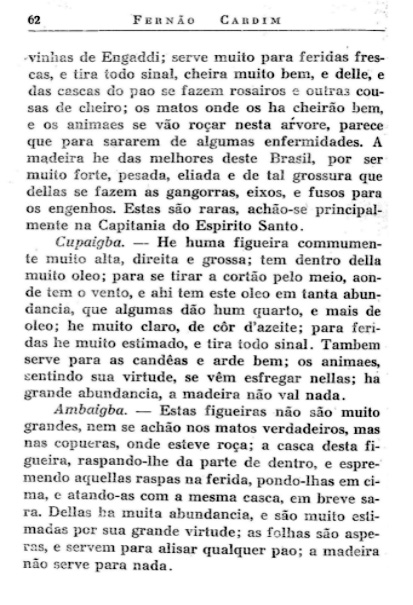
Do clima e da Terra do Brasil - Capoeira
Download the complete treaty in digitized PDF version by clicking here.
The Portuguese dictionary of the priest Rafael Bluteau (1638-1734)
The second proof that we have on the use of the term Capoeira, is in the dictionary of the priest Rafael Bluteau published in 1712: "Vocabulario Portuguez, e Latino" by Rafael Bluteau - Coimbra - Collegio das Artes da Companhia de Jesu - 1712.
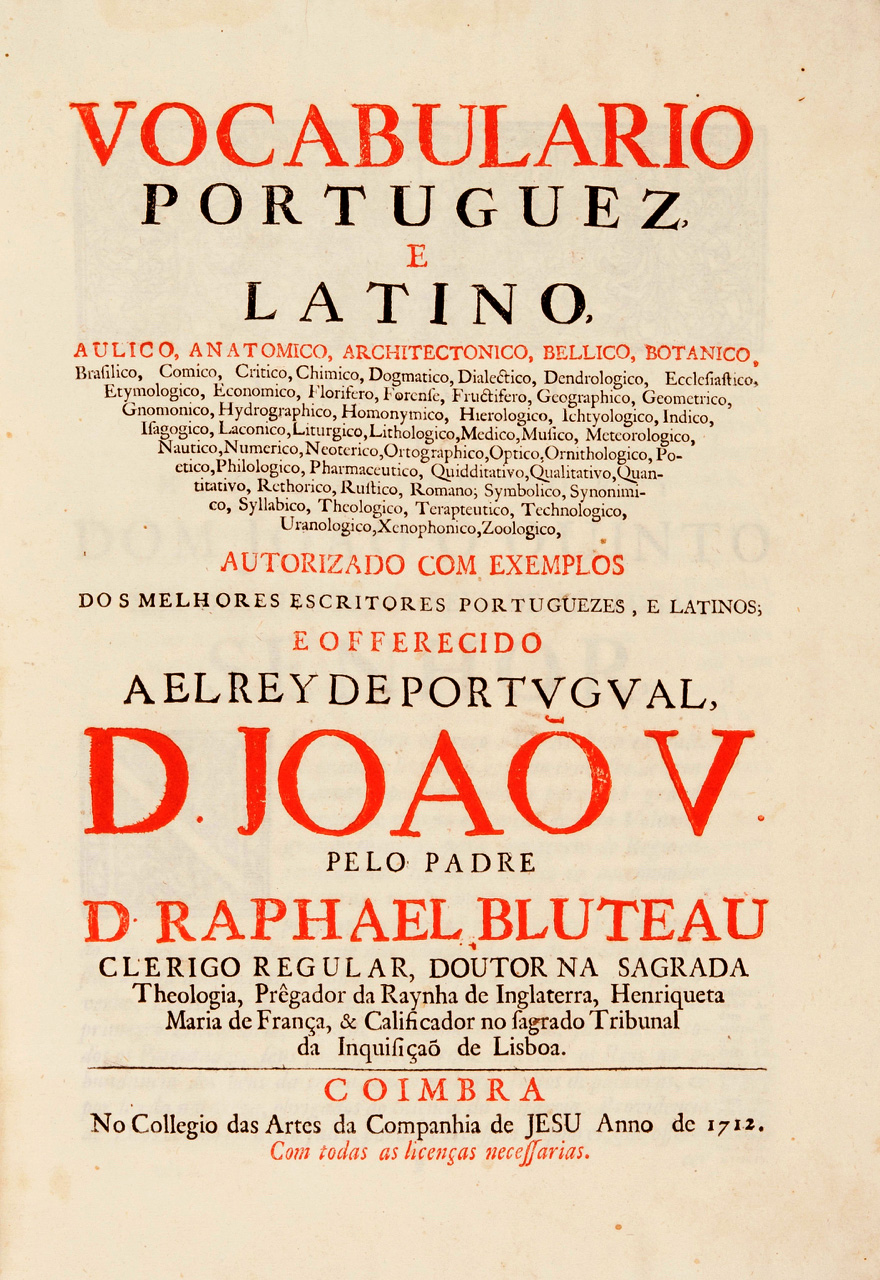
Vocabulario portuguez e latino, aulico, anatomico, architectonico, bellico, botanico, brasilico, comico, critico, chimico, dogmatico, dialectico, dendrologico, ecclesiastico, etymologico, economico, florifero, forense, fructifero... autorizado com exemplos dos melhores escritores portugueses, e latinos... Pelo padre D. Raphael Bluteau (1638-1734). Coimbra: no Collegio das Artes da Companhia de Jesu, 1712-1728, 10 vols. Portugal
In this work we find the words Capoeira and Capoeiro, which once again, does not designate a fight, but a hen cage (or a large round basket) for the first, and a hen thief for the second.
“CAPOEIRA. Gayola de Gallinhas. Cayea gallinácea. ... "
"Capoeira. (Termo da fortificaçaô.) Efpecie de ceflo muito grande, redondo, & fem fundojfeito de ramos entreíachados, & que fe enche de terra bem batida & fe poem em pê, para cobrir, os que fe defendem. ..."
"CAPOEIRO. Ladráo capoeiro. Que furta gallinhas na capoeira. ..."
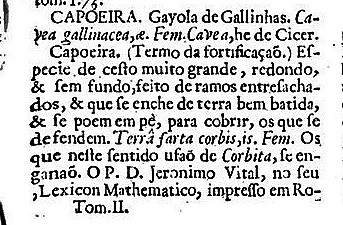
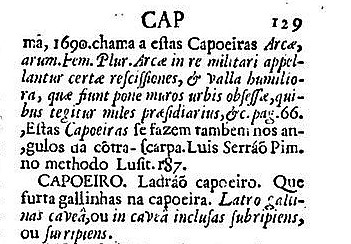
Page 129 of volume N ° 2/10 (Letra C) of Rafael Bluteau's Portuguese dictionary. Edition 1712. Digitized work in PDF format available here. (our images are taken from Page 353 of the PDF)
The priest was French. He arrived in Portugal in 1668. To learn more about his incredible history see here: https://pt.wikipedia.org/wiki/Rafael_Bluteau
